Designed for Distance
Every surface, every angle, every gram — optimized for maximum range and efficiency.
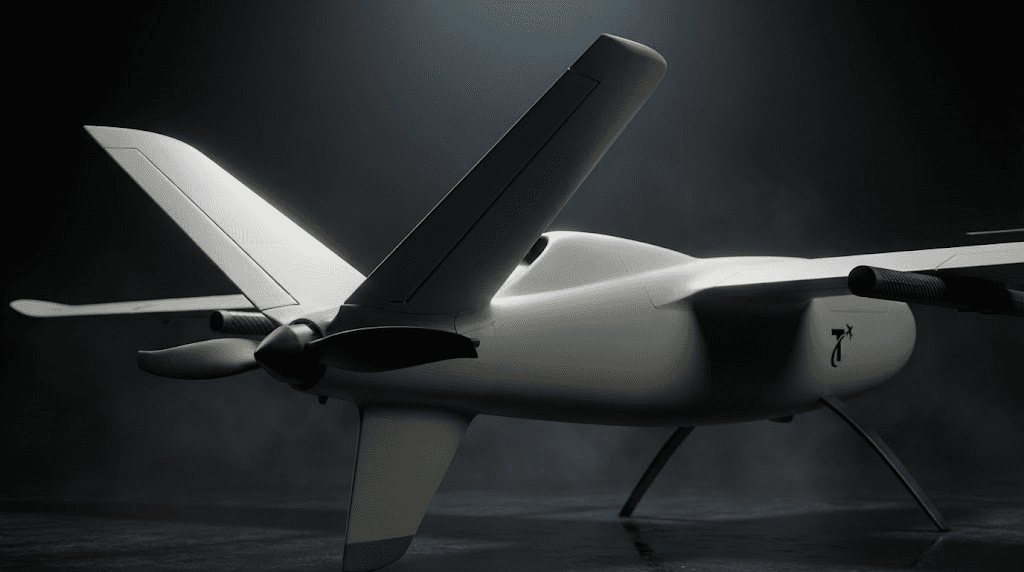
V-Tail Pusher Configuration
The Stork uses a V-tail pusher layout — the propeller sits behind the fuselage, pushing the aircraft forward through clean, undisturbed air over the wings. This eliminates the turbulence and efficiency losses of tractor configurations.
The V-tail replaces the conventional three-surface empennage with two angled stabilizers, reducing drag and weight while providing both pitch and yaw authority through differential deflection (ruddervators).
High-Wing Advantage
A high-wing mount places the wing above the fuselage, keeping the payload bay and avionics below the center of lift. This creates natural pendulum stability — the aircraft self-corrects in turbulence without burning compute or battery.
High-wing designs also protect the underslung camera and sensors during landing, and provide an unobstructed downward field of view for the DJI O3 system.
LW-PLA Airframe
The airframe is 3D-printed in lightweight PLA (LW-PLA), a foaming filament that expands during printing to create a closed-cell structure — strong, lightweight, and easily repairable.
LW-PLA achieves densities as low as 40% of standard PLA, enabling a complete airframe that weighs significantly less than comparable foam-core or fiberglass builds.
Carbon Fiber Reinforcement
Critical structural paths — the wing spar, motor mounts, and tail boom — are reinforced with carbon fiber tubes and strips. This targets rigidity exactly where loads concentrate, without adding weight where it doesn't matter.
The result is an airframe that handles the stress of VTOL transitions, cruise loads, and hard landings while staying under 3 kg all-up weight.
Technical Diagram
Labeled schematic of the Stork VTOL airframe and component layout.
Built to Go the Distance
Every design decision serves one goal — maximum range with zero compromise.
Configure Yours